SPACE EXPLORATION
The history of space exploration is a fascinating saga that began in the mid-20th century and continues today. Here is an overview of the key milestones in this story :
Early Space Age (1950-1960) :
- The Cold War between the United States and the Soviet Union was a major catalyst for space exploration. In 1957, the Soviet Union launched the first artificial satellite, Sputnik 1, marking the beginning of the space era.
- In 1961, Yuri Gagarin became the first human in space aboard the spacecraft Vostok 1.
- The United States responded by sending Alan Shepard into space aboard the Freedom 7 spacecraft in 1961, and then John Glenn orbited Earth aboard Friendship 7 in 1962.
Race to the Moon (1960-1970) :
- The moon race was an intense competition between the United States and the Soviet Union to be the first to reach the moon. In 1969, the United States won the race with the Apollo program, when Neil Armstrong and Buzz Aldrin became the first humans to walk on the Moon during the Apollo 11 mission.
- The Apollo missions continued until 1972, with a total of six successful missions on the Moon.
Robotic Exploration of the Solar System (1970-1990) :
- In the years following the Apollo missions, space agencies launched numerous robotic missions to explore the solar system. These missions included orbital probes, landers and rovers sent to the Moon, Mars, Venus, Jupiter, Saturn and beyond.
- In 1976, the first Viking landers landed on Mars, marking the beginning of intensive robotic exploration of the red planet.
Space Station Era (1990-present) :
- In 1998, the International Space Station (ISS) was launched, representing a major international collaboration between the United States, Russia, Europe, Japan and other countries.
- The ISS has become a low Earth orbit research laboratory, where astronauts conduct scientific experiments in areas such as biology, physics and space technology.
- At the same time, human exploration of Mars has become a major objective, with preparatory robotic missions and ambitious plans for manned missions in the near future.
Commercial Exploration (2010-present) :
- In recent years, more and more private companies have embarked on space exploration, developing technologies for commercial space travel, asteroid mining, and even settlement on the Moon and Mars.
- Companies such as SpaceX, Blue Origin and Virgin Galactic have played a major role in the space access revolution, reducing costs and stimulating innovation in space.
In summary, space exploration has come a long way since its modest beginnings in the 1950s. From historic missions to the Moon to the fascinating discoveries of robotic probes, space exploration continues to inspire humanity to dream new horizons and push the boundaries of our understanding of the universe.
Space exploration probe, rover
Space probes, rovers and manned missions are essential components of modern space exploration, each contributing in a unique way to our understanding of the universe. Here are some details about each of these types of missions :
Space probes :
- Spacecraft are unmanned spacecraft sent into space to explore planets, moons, asteroids, comets and other celestial bodies.
- They can be equipped with various scientific instruments, such as cameras, spectrometers, particle detectors and instruments for measuring the magnetic and gravitational fields.
- Space probes are often used to map the surface of planets, study their atmosphere, analyze their chemical composition, look for signs of life or geological activity, and investigate their past and evolution.
Rovers :
- Rovers are exploratory vehicles equipped with wheels and numerous scientific instruments, designed to move on the surface of planets or moons.
- They are usually remotely controlled from Earth and can travel long distances to investigate specific geological features, collect soil or rock samples, take high-resolution images and perform geochemical analyses.
- The most famous rovers include NASA’s Curiosity rover on Mars, which has been actively exploring the surface of the red planet since 2012, and the Perseverance rover, which landed on Mars in February 2021 as part of the Mars 2020 mission.
Inhabited Missions :
- Manned missions involve sending astronauts into space to conduct scientific research, perform maintenance work on space stations, or explore distant destinations such as the Moon or Mars.
- Manned missions are usually carried out aboard spacecraft, such as space capsules or reusable spacecraft, which provide a safe environment and vital support for astronauts during their journey into space.
- The manned missions have enabled remarkable achievements, such as the walk on the Moon during NASA’s Apollo program, the construction and operation of the International Space Station (ISS), and the preparation of future missions to Mars.
Together, space probes, rovers and manned missions help expand our knowledge of space, explore new worlds and set the stage for the future of human space exploration. Each of these types of missions provides valuable information that enriches our understanding of the universe and paves the way for new discoveries.
TRAVEL PROBES
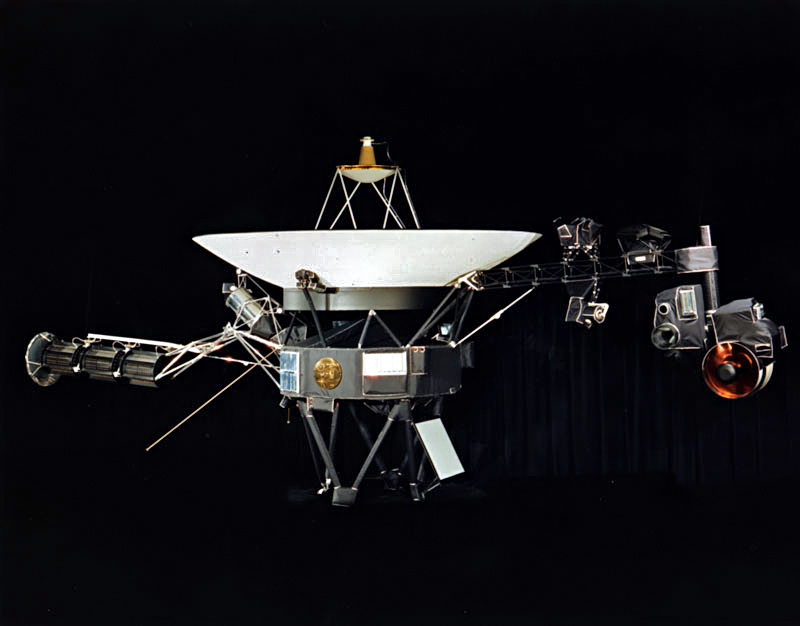
Voyager probes are among the most iconic missions in space exploration. Here are some details about Voyager probes :
Mission et Objectives :
- The Voyager probes were launched by NASA as part of the Voyager program to explore the outer planets of the solar system, including Jupiter, Saturn, Uranus and Neptune, as well as their moons and rings.
- Scientific objectives included the study of atmospheres, magnetospheres, radiation fields and surfaces of gas giant planets, as well as the search for moons and unknown structures.
Launch and Trajectory :
- Two identical Voyager probes, Voyager 1 and Voyager 2, were launched respectively in 1977, only a few weeks apart.
- The probes used a particular alignment of the outer planets to perform a "gravitational turn of force", which allowed to optimize their trajectory and propel them towards their respective destinations.
Major Discoveries :
- Voyager probes have revolutionized our understanding of giant planets and their systems. Notable discoveries include Jupiter’s Great Red Spot, Saturn’s intricate rings, Io’s volcanically active moons around Jupiter, and Titan’s icy moons around Saturn.
- Voyager 2 was the first and only probe to visit Uranus and Neptune, providing detailed images and data of these planets for the first time.
Interstellar Travel :
- After completing their mission to explore the solar system, the Voyager probes continued their journey into interstellar space. Voyager 1 became the first human object to leave the solar system in 2012, followed by Voyager 2 in 2018.
- The probes continue to send valuable scientific data about the interstellar environment, despite their considerable distance from Earth.
Golden Record :
- Each Voyager probe carries a special recording, the "Golden Record", containing sounds and images selected to represent the diversity of life and culture on Earth. These disks are intended to communicate with potential alien civilizations.
In summary, the Voyager probes are among the most successful and inspiring missions in the history of space exploration. Their journey continues beyond the confines of our solar system, carrying with them a message of discovery and exploration for future generations.
voyager 1
voyager 2
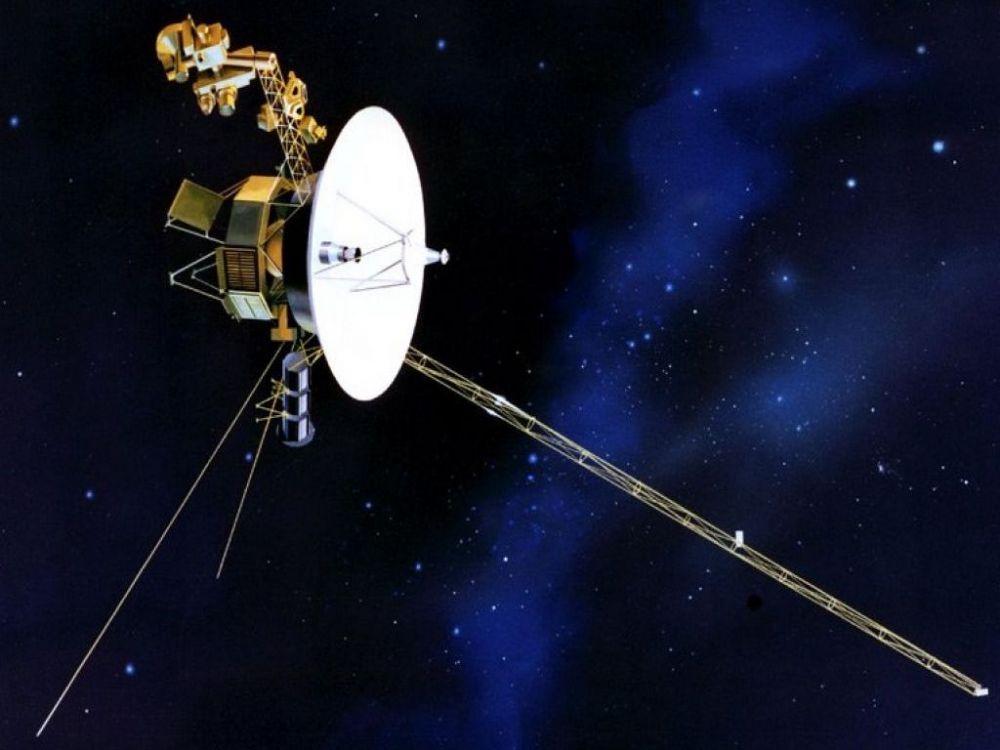
Photo of the earth taken by the probe Voyager 1 at about 22 billion km